



Over the past decades, global efforts to reduce childhood diarrhoeal disease have saved millions of lives. Yet that progress is increasingly under pressure. Diarrhoea remains one of the leading causes of death among children under five, and climate change is expected to intensify the conditions that allow these diseases to spread. Rising temperatures, heavier rainfall, flooding, and extreme weather events are altering water quality, sanitation systems, food safety, and patterns of exposure, particularly in settings already facing social and infrastructural constraints.
While the links between climate hazards and waterborne disease are well established, far less attention has been paid to the actions taken to reduce these risks. Research has focused on how climate change influences diarrhoeal disease, rather than on the adaptation interventions that might protect populations as those risks grow. Where adaptation has been studied, the emphasis has often been narrow, centring mainly on water, sanitation, and hygiene (WaSH) interventions.
Recent evidence has highlighted the limits of this approach. Large trials of some commonly used WaSH interventions in low- and middle-income countries have shown limited health benefits, raising important questions about whether current strategies are sufficient in a changing climate. At the same time, many interventions that could influence diarrhoeal risk, through agriculture, urban design, social protection, livelihoods, or health systems, are rarely considered through a climate–health lens.
This gap matters. Climate-sensitive diarrhoeal disease does not emerge from a single cause, but from the interaction of hazards, exposure, and vulnerability. Poverty, weak infrastructure, inadequate services, and environmental degradation can amplify the health impacts of climate shocks. Addressing these risks therefore requires looking beyond the health sector and recognising the role of adaptation actions across multiple domains.
The SPRINGS project was established to support more informed decision-making at the intersection of climate change and diarrhoeal disease. Working across research, policy, and practice, SPRINGS aims to help countries identify and prioritise interventions that can reduce climate-related health risks, particularly for vulnerable populations.
In this context, policymakers often face a practical challenge: while many adaptation actions are being implemented, there is no clear overview of what exists, how these interventions differ, and where evidence is available. Structured approaches for comparing and prioritising climate–health interventions remain limited, especially across sectors.
This document responds to that need. It brings together adaptation interventions identified through a scoping review, with the aim of making the landscape of options more visible. Rather than judging effectiveness, the mapping provides a foundation for discussion, comparison, and future assessment. It is intended as a starting point for priority setting, including the health technology assessment approaches that SPRINGS is developing in collaboration with stakeholders in countries such as Ghana and Romania.
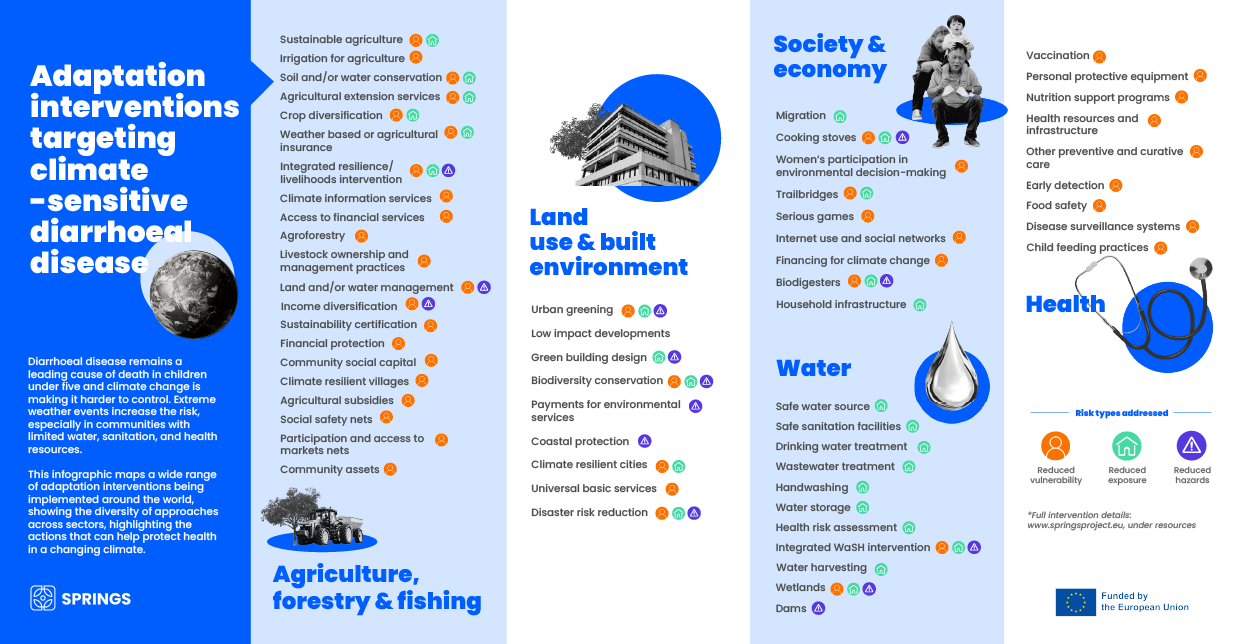
The document, produced by researchers from the SPRINGS project, presents a broad set of adaptation interventions that are relevant to climate-sensitive diarrhoeal disease and its determinants. These interventions span agriculture, land use and the built environment, water, health, and wider social and economic systems.
Each intervention is described using a consistent set of elements to help readers understand how it fits within the wider climate–health landscape. This includes practical examples of how the intervention has been implemented, the sector in which it operates, and the type of action it represents, from infrastructural and technological measures to social, institutional, and nature-based approaches.
The document also highlights how different interventions aim to reduce risk: by limiting climate hazards themselves, reducing exposure to those hazards, or addressing underlying vulnerabilities that make harm more likely. Where available, reported outcomes from the literature are included, alongside information on the countries or regions where interventions have been implemented.
Taken together, this mapping offers a cross-sectoral picture of how adaptation is already being used, or could be used, to reduce diarrhoeal disease risk in a changing climate. It also points to areas where evidence is thin and where future research and policy attention may be needed.
By making these interventions visible and comparable, the document seeks to support more integrated, climate-resilient approaches to protecting health, recognising that reducing diarrhoeal disease in the face of climate change will require action well beyond any single sector or solution.
You can access the document here.